Interpreting Our Heritage
A journalist visits America's national parks, and comes back with six rules for telling the story of a place.
Draft: moved over from the old WordPress site. The numbered footnote markers didn't come with a notes list, so they're left out for now. The full sources are below.
Through interpretation, understanding;
Through understanding, appreciation;
Through appreciation, protection.
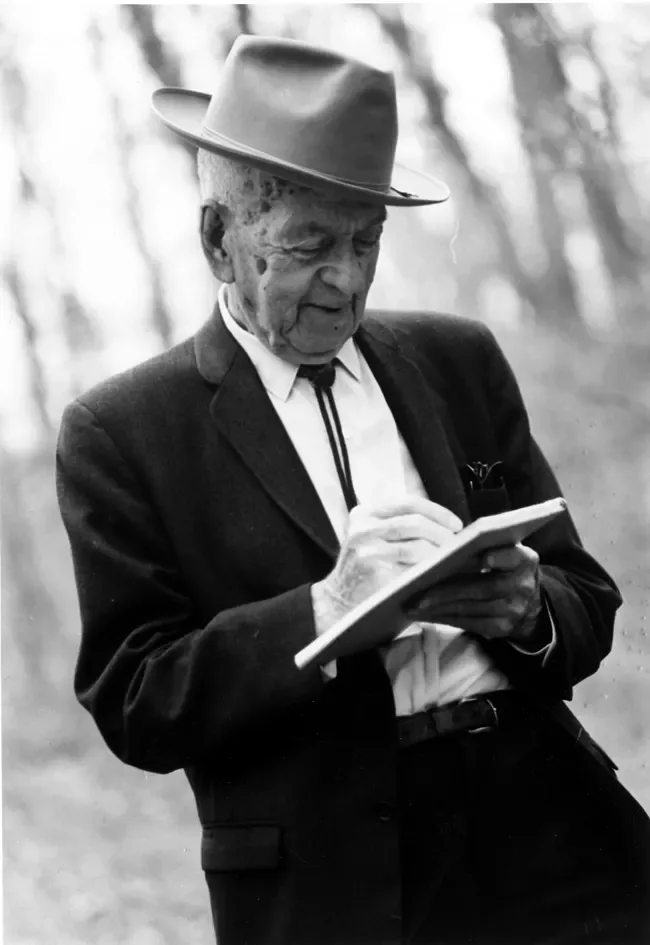
Freeman Tilden followed in his father's footsteps by starting a career in journalism, but his most celebrated work is his book Interpreting Our Heritage. Tilden wrote this book later in life after hearing someone from the National Park Service speak of amazing places such as Yellowstone, Yosemite, and others. Already having a love for conservation, Tilden became interested in the national parks and began working for the National Park Service. Tilden's new responsibility was to visit the parks, and then "formulate a plan for public relations and interpretation." After his visits, Tilden defined interpreters' jobs at these sites as "the work of revealing, to such visitors as desire the service, something of the beauty and wonder, the inspiration and spiritual meaning that lie behind what the visitor can with his senses perceive." Tilden got first-hand experience with interpretations that did and did not work for the park visitors, so he wrote Interpreting Our Heritage "to provide readers with the essential philosophy that underlies the art of interpretation." His passion for conservation and the spread of that love is apparent in each chapter, where he breaks down the art of excellent interpretation to six distinct attributes.
1. Make it relevant
Why is this important? And more importantly, why is this important to me (the visitor)?
Tilden's first rule is that the interpretation must be relevant to the visitor. Visitors enter museums to discover one thing; they are "… looking for the answer to one question: 'Why is this important?'" And more importantly, why is this important to me (the visitor)? It is not acceptable for an interpreter to share information just to share it. To relate to the visitor, interpreters can connect the visitor to the place by saying "you" and "here." The appropriate wording is vital, as Tilden plainly states: "If you cannot connect to his ego with the chain of your revelation, he may not quit you physically, but you have lost his interest."
2. Give perspective
Tilden's second attribute of good interpretation is adding perspective. "This device of interpretation, brought home, could be used in giving an adequate notion of the magnitude…" In other words, the visitor should be able to go somewhere else and talk about the museum or display and relate it to others as well. A fantastic example of showing perspective is when the American Museum of Natural History in New York built a lifelike Titanosaur. This 122-foot-long display extended beyond the walls and gave visitors a visual of what 122 feet is. For decades these visitors will be able to describe the visual of the Titanosaur to others, where if there had only been a picture and a label, the size would never have imprinted on the visitors.
3. Tell it as an art
For the third attribute, Tilden explains that interpretation is a true art form. Tilden writes, "The interpreter who creates a whole, pares away all the obfuscating minor details and drives straight toward the perfection of his story will find that his hearers are walking with him – are companions on the march." This art form is about creating narratives where visitors lean into the story – where the visitor's imagination takes over, and he hears the sounds and smells the smells. Good storytellers have everyone feeling they are right there in the thick of things and to the visitor, "At some certain point, it becomes their story as much as his." Interpreters can accomplish this in different ways, but a simple way is to assign names to the characters in a story. Instead of saying "the slave," give her the name of Martha and the plantation owners as Mr. and Mrs. Smith. This personalization of the story makes it more real, and "The audience no longer thinks of history as a faceless collection of social classes and activities but as flesh and blood."
4. Provoke, don't just teach
For his fourth attribute, Tilden states that interpreters must not just be teachers, but they must aim to provoke the visitor to take further action on their own. Tilden admits, "It is true that the visitors to these preserves frequently desire straight information." However, he goes on to say that interpreters must encourage the visitor "…toward a desire to widen his horizon of interests and knowledge, and to gain an understanding of the greater truths that lie behind any statements of fact." The point here is that visitors should learn to want to think "…historically, asking questions about the past, and exploring how history relates to our lives that matter." History has effects on everyone; the interpreter must lead the visitor to understand that.
5. Show the whole
Interpreters must address the whole, not only part of the story. This is Tilden's fifth attribute of sound interpretation, which works well with the second attribute of giving perspective to the visitor. Addressing the story as a whole is imperative for interpreters, as this allows the visitor to understand the context of the event or item. Tilden explains, "It is far better that the visitor to a preserved area, natural, historic or prehistoric, should leave with one or more whole pictures in his mind than with a mélange of information that leaves him in doubt as to the essence of the place, and even in doubt as to why the area has been preserved at all." When considering sharing the story as a whole, interpreters should explain the entire situation – both the good and ugly. "Do we only want to preserve parts of the past that we can celebrate as a community or nation? Or do we want to preserve and be forced to reconcile evidence of slavery?" As explained earlier, visitors should understand the full context of the situation, but without any extra details, so the interpreter is "covering a broad swathe of chronology without being too granular."
6. Speak to children differently
Lastly, Tilden addresses how the interpreter should work with children. The interpreter must not exclude any adults unless the program is specific for children; however, children do require special handling. The interpreter must connect the dots for the children so that children are more likely to understand the whole story and the perspective. Interpreters must not avoid using words that will not likely be in a child's vocabulary, but they do need to make sure the child understands the term. Tilden explains this by stating, "I realize now that hard words are exactly those that represent things we are not prepared to be interested in." If the interpreter prepares the child to be interested, he will more likely retain their attention.
It is no surprise that Interpreting Our Heritage has become the go-to, how-to for interpreters. Tilden's six characteristics of proper interpretation apply not only to museum interpretation but can also extend to the art of public speaking and salesmanship. Tilden best explained his passion for conservation, and his wanting to spread that love, when he borrowed a line from the park service administrative manual: "Through interpretation, understanding; through understanding, appreciation; through appreciation, protection."
Sources
- Alexander, Edward P., Mary Alexander, and Juilee Decker. Museums in Motion: An Introduction to the History and Functions of Museums. Lanham, Maryland: Rowman & Littlefield, 2017.
- Gardner, James B., and Peter S. LaPaglia, eds. Public History: Essays from the Field. Malabar, Fla.: Krieger Pub., 2006.
- Lyon, Cherstin M., Elizabeth M. Nix, and Rebecca K. Shrum. Introduction to Public History: Interpreting the Past, Engaging Audiences. Lanham: Rowman & Littlefield, 2017.
- Tilden, Freeman. Interpreting Our Heritage. Edited by R. Bruce Craig. Chapel Hill, NC: University of North Carolina Press, 2008.