The Warning That Arrived Through a Side Door
In 1605, the tip that saved Parliament came unsigned, from a stranger in the road.
Most warnings of disaster don't arrive with a bow on top. The one that saved Parliament in 1605 didn't even have a signature.
On October 26, 1605, a stranger in the road handed an unsigned letter to a servant outside Lord Monteagle's house in Hoxton.
The letter advised Monteagle to find an excuse to skip the opening of Parliament, because it was about to take a terrible blow. It named no one and came through no office.
Who wrote it is still debated. Francis Tresham, Monteagle's brother-in-law, is the usual suspect. Antonia Fraser argues Monteagle wrote it himself after Tresham warned him in person.
Monteagle took the letter to Robert Cecil, the Earl of Salisbury, and it reached King James on November 1. Searches of the vaults under Parliament followed on November 4. In the early hours of November 5, Guy Fawkes, who had given his name as John Johnson, was found with fuses and matches. The alias didn't help.
Nine days from anonymous tip to search. Some ticketing systems would call that a fast turnaround.
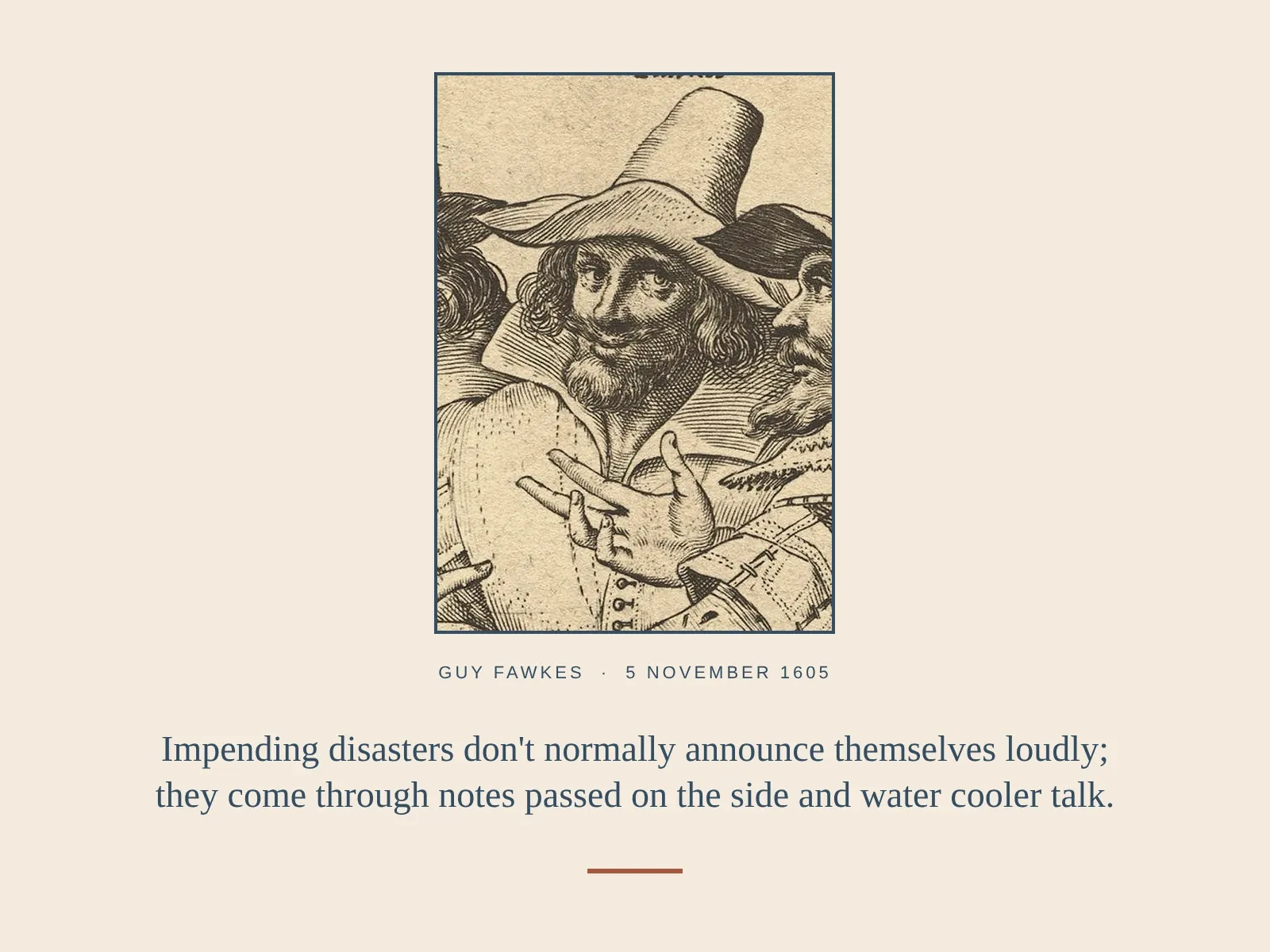
History has a point.
Anyone who's received the most important warning of the quarter as a Slack DM, a hallway comment, or an unsigned note knows the setup. Warnings rarely arrive through the official channel. They arrive through whoever happened to notice.
Every team also has the person who announces a disaster every Tuesday and the one who speaks up twice a year from the back of the room. Only one of them has a track record.
So, managers: learn which is which before the warning arrives. Decide who reads the sideways warning, who decides what happens next, and who's not allowed to dismiss it for lacking a ticket number. Volume isn't a track record.
The parallel isn't perfect. The letter threatened Monteagle's own neck, which is a strong incentive to escalate, and historians still argue over whether it was a tip or a carefully written alibi.
Know who to listen to, and make it easy for them to be heard.
Sources
- Antonia Fraser, The Gunpowder Plot: Terror and Faith in 1605, Weidenfeld & Nicolson, 1996.
- Mark Nicholls, Investigating Gunpowder Plot, Manchester University Press, 1991.
Also shared on LinkedIn.